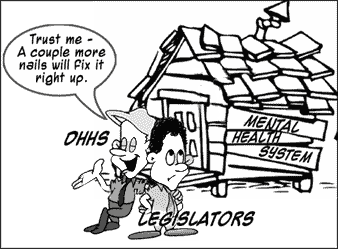
PBH: Compliance and contempt

While it details non-compliance in meeting a court order that led to Piedmont Behavioral Healthcare being held in contempt of court, a September opinion from the NC Court of Appeals also cites the agency’s arguments that it is literally above the law, at least as far as the state’s mental health statutes are concerned.

And in ruling against PBH’s arguments that it is protected from court action by sovereign immunity, the Appeals judges added yet another interesting twist to the unique and dysfunctional chaos that is the state’s mental health system.

The Court of Appeals findings stem from a March 26, 2010, order from Davidson County District Court that PBH provide PRTF placement and other necessary services to meet the mental health needs of a minor child under DSS guardianship or to appear in court and explain why it was not meeting the order. DSS had been seeking services for the child since August 2009. [Read more...]

PBH: A tangled web ….

Piedmont Behavioral Healthcare (PBH) has finally honored North Carolina Mental Hope’s request for copies of minutes from its board of director’s meeting, a packet of printouts arriving last Friday. While I have not had time to delve into them, I finally made time this afternoon to respond to an email from Rep. Fred Steen’s office regarding its investigation into PBH’s compliance with the Open Meetings Law. That email, circulated to HHS LOC committee members and others, is repeated below, followed by my response to the conflicting, illogical and at times outlandish defense of PBH. [Read more...]

PBH: Playing Legislators for Fools?

The question of whether Piedmont Behavioral Healthcare is playing legislators for fools would seem a fair one in light of an email from CEO Pam Shipman circulated to members of the Health and Human Services Legislative Oversight Committee regarding North Carolina Mental Hope’s July 26 request for minutes of PBH board of directors meetings.

Copies of that Nov. 3 email and the response this past Satuday after becoming aware of it are included below. Key points/counterpoints of Shipman’s response to an inquiry from Rep. Pat Hurley’s office:

      • What Shipman says: PBH makes all records subject to public records law available upon request in accordance with state law.
      • What the law says: Shipman includes the opening paragraph of Chapter 132 of the General Statutes, the Public Records Law but incredibly chooses to ignore the second part of the very sentence she offers to support her contention that PBH is complying with the law, the part that requires copies of records to be provided upon request. While the rest of Chapter 132 spells out a public entity’s obligations in meeting its provisions, those obligations are clearly and simply stated on the first page of the Attorney General’s “Guide to Open Government and Public Records.”
      •  

      • What Shipman says: “We have had a number of communications with Mr. Cornwell” …. and he has “repeatedly declined” invitations to come view the records.
      • What the record shows: Three email responses and one phone call from PBH communications director Cyndy Brooks in 121 days (all communication from PBH compiled here; it is a short read).
        • First two emails: Disregarding provisions of Chapter 132 that say no formal document or procedure can be required for making a public records request, the first responses to our request attempt to do just that. In each instance (seven weeks apart), I refer PBH to the statutes and Attorney General’s guide.
        • A September 16 email seeks to make arrangements for me to come view the Board minutes, again ignoring the law’s requirements that copies be provided upon request and the spirit of the law to make public documents readily accessible to all taxpayers. Requirements outlined in the Attorney General’s guide continue to be ignored.
        • Brooks calls to follow up on making arrangements for viewing the minutes. I again point out PBH’s legal obligation to require copies upon request, but ask how many of the older files are stored off-site, in what format, and why they have to be scanned rather than copied. Conversation ends with Brooks saying she will get back to me with answers to those questions.
      • What Shipman says: “He demands that the materials be retrieved, converted to electronic format, and sent to him at no cost.”
      • What the record shows: I refer again to the record of communications with PBH, in which no such demands have been made. It would certainly be my expectation that most, if not all, of the requested records would already be electronic files, since the day of typewriters is long past. It would also be my expectation that costs associated with copying those files would be negligible since four other LMEs responded to our request at no charge and since complying with the law should be as easy as copying text files to a CD or sending as email attachments.

Adlous Huxley observed that facts don’t cease to exist because they are ignored. But PBH administrators are apparently hoping that the Public Records Law as it applies to them will cease to exist if they can ignore it long enough for revisions to be made to Chapter 122C of the General Statutes. The best the public can hope is that if PBH is indeed playing them for fools, legislators won’t let them.

David Cornwell
Executive Director
North Carolina Mental Hope
 

PBH on records request

Note: The following is a Nov. 3 email from PBH CEO Pam Shipman to legislative assistant Susan Whitehead in the office of Rep. Pat Hurley’s office and distributed to Hurley and other members of the Health and Human Services Joint Legislative Oversight Committee.
PBH makes all records subject to the public records law available upon request in accordance with the NC requirements for disclosure of public records cited below:

§ 132‑6. Inspection and examination of records.

(a) Every custodian of public records shall permit any record in the custodian’s custody to be inspected and examined at reasonable times and under reasonable supervision by any person, and shall, as promptly as possible, furnish copies thereof upon payment of any fees as may be prescribed by law.

I assume the complaint from … is regarding the requests of David Cornwell of Mental Health Hope for copies of our Board minutes back to 2003. To my knowledge we have no requests from … to access our Board minutes.

We have had a number of communications with Mr. Cornwell in which we have offered to retrieve the Board minutes from off-site storage, bring them to PBH, make them available for his inspection, and allow him to have copies of any of the materials at our cost. However, Mr. Cornwell has repeatedly declined, Instead, he demands that the materials be retrieved, converted to electronic format, and sent to him at no cost.

There is no requirement that Board minutes be posted on the website of any LME. However, Mr. Cornwell’s request was reviewed by the PBH Board of Directors at our August 2011 meeting, and the Board voted to post approved minutes to our website on a go forward basis.

Thank you very much for checking with us. Please let me know if you have any further questions. Pam
 

North Carolina Mental Hope’s response

Note: The following is my Nov. 19 response after becoming aware of the Nov. 3 email from PBH CEO Pam Shipman.

Dear Legislators,

I will leave it for each of you to determine if it is Ms. Shipman’s intent is to play you for fools or not. She seems to be oblivious to the second part of the legal reference she provides requiring public entities to “as promptly as possible, furnish copies” of requested documents, as well as to the rest of Chapter 132 of the General Statutes, the Public Records Law.

On the first page of its “Guide to Open Government and Public Records,” the state Attorney General’s office clearly states how to make a public records request and the required response of agencies to such a request. The requirement for requesting records is simply to ask. The required response is to determine whether the request is for copies or to inspect records. The agency is then to determine a cost of making copies, if any, and then notify the requesting party as to that cost and a timetable for providing the copies.

The sum total of the communication with PBH is documented here. It’s a short read that speaks volumes to the validity of Mrs. Shipman’s response. As you’ll note, I have consistently informed them of the requirements of the law. There has been no offer to make or provide copies at PBH expense as Ms. Shipman states. There has been no insistence that the files be converted to electronic format nor that they be provided at no cost.

State statute is very specific about what allowable costs are and the pertinent paragraph of the General Statutes is provided below. A public entity is not allowed to charge for costs it would have incurred anyway. Therefore, a reasonable expectation is that the cost of providing electronic records would be negligible, since it should at most require a staff person perhaps 10 minutes to copy files to a CD. The only cost I have received from PBH is a price of 75 cents per page to scan older records that are stored off-site. They have not informed me the number of pages stored off-site or why they need to be scanned as opposed to simply being copied. I will note that a similar request for records was made from four other LMEs, all of which have provided those documents at no charge.

In my commentaries on the subject, I have questioned why records from 2003 or since would be paper only and stored off-site, reminding readers that 2003 was the “Dark Ages of Computing when Windows XP ruled the land, the iPod was just in its third generation, and Smartphones just weren’t as smart as they are today.” Certainly it should be a concern if the legislatively mandated model for the state’s MCO/LMEs should be so technologically backward that it could not easily retrieve these records.

Finally, I refer you to Ms. Shipman’s statement that “PBH makes all records subject to the public records law available upon request in accordance with the NC requirements.” And again, I think it’s fair to ask if her intent is to play you for fools. Apparently, I can see the minutes on PBH’s terms rather than the law’s. Was the intent of those who wrote the legislation that I take a day off from work, rent a car since mine is no longer trustworthy for longer trips, drive 2.5 hours and wait for PBH to produce and copy board minutes for an unknown cost (or free as Ms. Shipman now indicates) and then drive 2.5 hours home? Or was the legislation’s intent to make records of public agencies easily and readily available to the taxpayers who footed the bill for those records.

As mentioned, I have written on PBH’s refusal to provide copies of its minutes in violation of state law a number of times. A box with links to those commentaries is in the top right of our website’s home page at ncmentalhope.org. In those comments, I conjecture on possible reasons for PBH’s non-compliance and question the integrity of an organization that so brazenly flouts the law as well. To me, it would seem common sense for you to question their integrity, too.

David Cornwell
Executive Director
North Carolina Mental Hope

PBH: What does the silence have to say?

Actions may speak louder than words, but silence often speaks louder than either.

With the 3-month anniversary of North Carolina Mental Hope’s request for board minutes of Piedmont Behavioral Healthcare just passed, it seems an appropriate time to ask what the silence of the LMEs administrators, of legislators and of advocates has to say.

The silence of PBH: It doesn’t take an advanced degree in common sense to have sense enough to ask what they’re hiding. And if not hiding anything, what does it say about the organization’s integrity that the prevailing mindset is apparently one of fear or uncertainty that something adverse to its interests might be found? What does it say about an agency’s integrity that it chooses to hold itself above the law? To me, it screams they have none. And yet, it is the chosen model for others to emulate in building the bedrock of our state’s system for the delivery of mental health, developmental disability and substance abuse services. [Read more...]

The logic of more powerful LMEs

If opponents of increased powers for the new Super LME/MCOs would just look at the issue logically, they’d be hard pressed to argue that it’s any less logical than most other decisions made in connection with the state’s mental health system over the past decade.

With New River Behavioral Healthcare losses of at least $6.5 million while under the oversight of the Smokey Mountain Center LME, it’s only logical to make LMEs more powerful with less oversight of themselves.

With Piedmont Behavioral Healthcare flaunting the state’s Public Records Law now for almost three months in ignoring a request for copies of its board minutes and requiring nondisclosure agreements, it’s only logical to make LMEs more powerful, including exempting them from provisions of the Public Records Law. [Read more...]

Mastering the Raleigh Sidestep

While it may not be enough to earn an invite to Dancing With The Stars, Assistant DHHS Secretary Beth Melcher did show her mastery of the Raleigh Sidestep last week in answering a question on consumer inclusion from a member of the Health & Human Services Legislative Oversight Committee.

Asked by Sen. Tommy Tucker, R, District 35, if there were a fair number of people on the “task force” reviewing the Department’s strategic plan for waiver implementation, Melcher replied:

“I wish I knew of a perfect system to get everybody’s input. I don’t  know of anyone who’s discovered that.” DHHS needs to develop multiple ways of getting input, she said, adding there is indeed a mechanism in place for receiving input moving forward as waivers are implemented and that conversations are ongoing on the best folks to serve and the best way to get input.

“It’s certainly our intent to try and get a broad range of input and opinion,” Melcher said, then described the challenge of getting input from individual service recipients through customer surveys and town hall meetings. And while that particular input has nothing to do with the strategic plan, it makes it sound like much is being done. [Read more...]

New River CEO addresses allegations

A rose by any other name would smell as sweet, but for New River Behavioral Health Care CEO Pam Andrews, fraud by another name would be more accurate and sting substantially less.

In a statement dated Wednesday outlining the chronology of events that led to the agency’s closing, Andrews takes exception to the use of the word “fraud” by the Division of Medical Assistance to describe New River’s difficulties.

“Fraud is an alarming word on its own and is compounded when it is accompanied by financial concerns. An accusation of fraud can result from something as simple as a document that hasn’t yet been uploaded to a patient’s file or from much more complex and even illegal actions. New River has done nothing illegal.”
[Read more...]

How much change, how soon?

Sometimes it’s important to note things if only to have them on record. Such is the case with DHHS Deputy Secretary Mike Watson’s comments Tuesday regarding proposed changes to provisions of Chapter 122c of state statutes governing Local Management Entities.

In presenting a broad overview of the issues DHHS says have arisen as LMEs become the new Super LME/MCOs (managed care organizations), Watson said: “The overall plan would be to come back in a session in November with a very limited request granting the Secretary the opportunity to perhaps waive some provisions of 122C and then to have the opportunity in the short session to have a more robust discussion about what changes might need to be made.”

And while Watson told the committee the same thing a bit later as well, that’s not necessarily a reason to believe proposals dramatically changing the nature and power of LMEs won’t pop up during next month’s special session anyway, introduced by a legislator at special interests request. During his presentation, Watson noted areas for change might include: board size and composition, the role of the executive committee, pay, fund balance restrictions, the ability to own property and borrow money. [Read more...]

New River Behavioral Health Care: Waiting for the autoposy

With the announced closing of New River Behavioral Health Care, the mayhem that is the only constant in the state’s mental health system has claimed yet another victim.

According to news reports, the former LME that morphed into a provider agency after its July 2007 merger with Smoky Mountain Center is almost $3 million in debt and being audited, with commissioners from the counties served holding emergency meetings to see how best to continue services to the agency’s 13,000 clients and hopefully retain jobs for its 300 employees. And, of course, they’re trying to sort out who’s responsible for the agency’s bills as well.

Beginning in the ’60s as a community mental health center, the reasons for New River Behavioral Health’s demise are likely complex and varied. But before the agency becomes just another footnote to more than a decade of chaos, it’s worth considering how the continued consolidation of providers and LMEs may have affected New River’s financial health. At the very least, it’s worth considering the power that LMEs have to make or break an agency. And on the surface at least, the decision by Smoky Mountain Center to award a contract for services in its Central Region to RHA Health Services could be seen as the final nail in NRBH’s coffin. [Read more...]

Another wrecking ball for state’s system

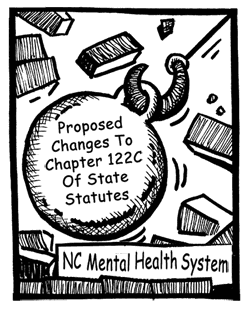
Not content with just being the model for the restructuring of the state’s MH/DD/SAS system, Piedmont Behavioral Health is apparently ready to take a wrecking ball to a system already teetering on collapse. In a planning document dated 9/26/11,“Proposed Changes to 122C and Public Authority Comparison Chart,” proposed changes would:

  • Remove requirements that county commissioners serve on LME boards as well as requirements for geographical representation
  • Remove counties from virtually any control over LMEs
  • Exempt LMEs from the Local Government Finance Act and remove fund balance restrictions
  • Allow LMEs to purchase, hold title, improve and finance real estate
  • Grant exemptions to the state’s Public Records Law that keeps LMEs from controlling the use of intellectual property
  • Allow LMEs to “take advantage of any emerging opportunities” in introducing new product lines and services
  • Exempt LME staff from the State Personnel Act and remove salary limitations
  • Have Medicaid waiver appeals heard by a DMA hearing officer rather than the Office of Administrative Hearing

[Read more...]